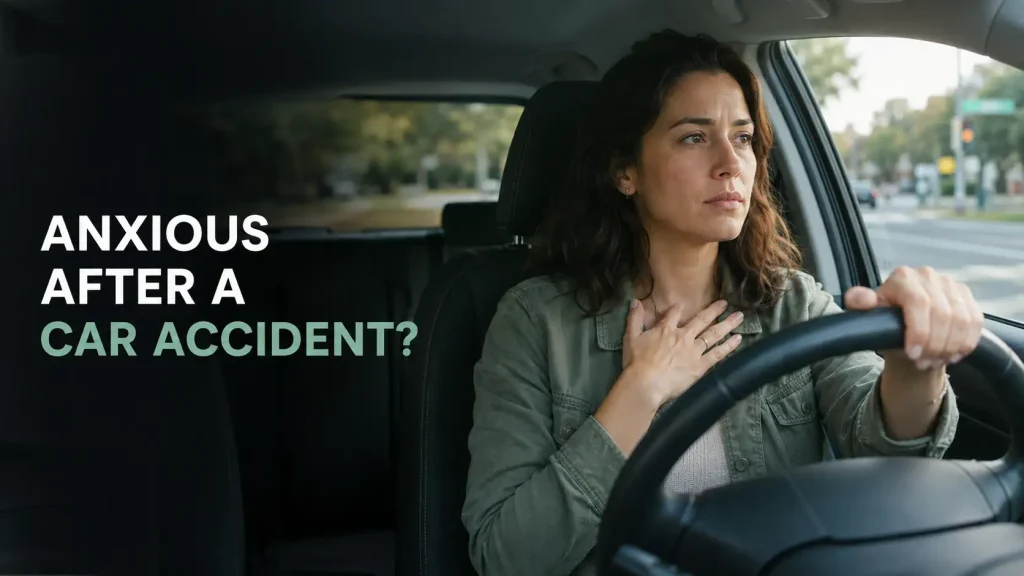
The accident is over. Your car may have been repaired, your physical injuries may be improving, and everyone around you may expect life to return to normal. But when you hear tires screech, approach the intersection where it happened, or notice another vehicle getting too close, your body reacts as though you are in danger again. This is how car accident trauma can continue affecting you long after the crash itself.
When someone comes to me after an accident, they do not always describe what they are experiencing as trauma. They may simply say, “I don’t feel like myself,” “I can’t relax in the car,” or “I keep thinking about what could have happened.” Those reactions deserve to be taken seriously.
The Accident Ended, but Your Body May Still Feel Unsafe
During a car accident, your mind and body respond quickly to protect you. Your heart races, your muscles tighten, and your attention locks onto the danger. That survival response is useful in the moment.
The difficulty begins when that internal alarm remains active after the immediate danger has passed. You may understand logically that you are safe, but your body may not respond that way.
A sudden horn, hard braking, heavy traffic, or even getting into the driver’s seat can trigger the same fear you experienced during the accident. This does not mean you are weak or overreacting. It means the experience affected your sense of safety, and your mind is still trying to protect you from it happening again.
What Car Accident Trauma Can Look Like in Daily Life
Trauma after a crash does not look the same for everyone. Some people become afraid to drive. Others continue driving but feel tense during every trip. You might experience symptoms immediately, or they may become noticeable days or weeks later.
Common reactions can include:
- Feeling anxious while driving or riding as a passenger
- Avoiding highways, intersections, certain roads, or driving altogether
- Replaying the accident or imagining how it could have been worse
- Feeling unusually alert to traffic, sounds, movement, or other drivers
- Experiencing panic, a racing heart, sweating, shaking, or shortness of breath
- Having nightmares or difficulty sleeping
- Feeling irritable, emotionally disconnected, or unable to concentrate
- Blaming yourself, even when the accident was not your fault
Sometimes the reaction is very specific. You may drive normally until a truck pulls beside you, it begins raining, or you reach the type of intersection where the crash occurred. These details help us understand what your nervous system has connected with danger.
You Do Not Need a Severe Physical Injury to Be Affected
People often minimize their emotional response because they walked away without a serious injury. They tell themselves that someone else had it worse or that they should simply be grateful and move on.
But emotional trauma is not measured only by physical damage. A collision can feel terrifying even when the resulting injuries are considered minor. You may have believed, even briefly, that you or someone you love could be seriously hurt or killed.
The aftermath can add another layer of stress. Medical appointments, pain, missed work, insurance calls, transportation problems, and financial uncertainty can prevent you from feeling that the event is truly over.
You do not have to prove that the accident was “bad enough” before asking for support.
How We Approach Car Accident Trauma Therapy

When we work with someone affected by a car accident, my first goal is not to push them into retelling every detail. My goal is to understand what is happening now, what feels difficult, and what they want to regain.
Our work is personalized because two people can experience similar accidents and have completely different reactions.
We Begin With What You Are Experiencing Now
You may want to drive without panicking, sleep through the night, stop replaying the accident, or feel comfortable riding with someone else. We begin with the part of your life that has been most affected.
During car accident trauma therapy, we can identify the situations, thoughts, sounds, and physical sensations that activate your fear response. Understanding those patterns can make the reactions feel less confusing and more manageable.
We Build Tools You Can Use in Real Situations
We help clients develop practical ways to respond when anxiety rises. This may include grounding techniques, breathing strategies, recognizing fearful thought patterns, and learning how to bring attention back to the present moment.
Cognitive Behavioral Therapy can also help us examine thoughts such as “I am never safe in a car” or “Another accident is going to happen.” The goal is not to pretend risk does not exist. It is to prevent fear from treating every drive as an emergency.
You can also explore some of the CBT techniques you can use outside therapy to understand how these skills may support you between sessions.
We Move at a Pace That Respects Your Readiness
We do not believe in forcing someone into a frightening situation before they feel prepared. Recovery is not about proving that you can tolerate distress. It is about rebuilding safety, confidence, and control gradually.
For one person, progress may mean sitting in a parked car without becoming overwhelmed. For another, it may mean driving around the block, returning to the highway, or passing the location where the accident occurred.
Each step should be connected to your goals, not someone else’s timeline.
When Should You Consider Talking to a Therapist?
There is no required waiting period before seeking help. You can reach out when you notice that the accident continues to affect your sleep, concentration, mood, relationships, work, or ability to travel.
Support may be especially helpful when:
- Your reactions are not becoming easier over time
- You are changing important parts of your life to avoid driving
- Panic or intrusive memories feel difficult to control
- You feel emotionally disconnected or constantly on guard
- Family members do not understand why the accident still affects you
- You want help before fear becomes more established
You do not need a formal diagnosis before starting therapy. We can begin with what you are experiencing and determine together what kind of support makes sense.
Car Accident Trauma Therapy in Glen Ellyn and Across Illinois
At Healing Helps Therapy, we provide a calm, judgment-free space where you can talk about what happened without being rushed or dismissed. Your cultural background, family expectations, responsibilities, and personal understanding of the accident all have a place in our work.
In-person sessions are available in Glen Ellyn. If traveling to the office feels difficult or you live elsewhere in the state, secure telehealth therapy is available across Illinois.
You Deserve to Feel Safe Again
You may not be able to erase what happened, but the accident does not have to control every trip, every sound, or every decision you make. With the right support, you can understand your reactions, develop practical coping tools, and begin rebuilding confidence at a pace that feels manageable.
If you are struggling with anxiety, fear, or intrusive memories after a car accident, you can contact Healing Helps Therapy to request a free consultation. We can talk about what you are experiencing and whether working together feels like the right next step.