

Knowing how to set therapy goals can feel difficult when you cannot clearly explain why you want therapy in the first place. You might know that something has changed, that certain situations feel harder than they used to, or that you are simply not functioning or feeling the way you want to. You do not necessarily need a polished explanation before beginning. A useful starting goal can be as simple as understanding what has been happening and identifying what you would like to feel, handle, or experience differently.
Therapy goals can become more specific as you notice patterns, put experiences into words, and understand which parts of your life are being affected.
What Can a Therapy Goal Look Like When You Do Not Know What Is Wrong?
A therapy goal does not always need to begin with the name of a specific problem.
You may initially be able to describe what you are noticing more easily than why it is happening. For example, you might say:
- “I don’t feel like myself lately.”
- “I keep getting overwhelmed.”
- “Small things affect me more than they used to.”
- “I have trouble relaxing even when nothing is happening.”
- “I keep avoiding things I know I need to deal with.”
- “My relationships feel harder.”
- “I feel stuck, but I don’t know what needs to change.”
- “Everything looks fine from the outside, but something feels off.”
These statements already provide somewhere to begin.
Instead of making your first goal “fix whatever is wrong with me,” a clearer early goal might be:
“I want to understand what has been making everyday life feel harder.”
That gives therapy a direction without requiring you to diagnose yourself.
Start With What You Notice, Not What You Think You Should Call It
People sometimes assume they need the correct psychological term before they can explain what they are experiencing.
A more useful starting point is often the experience itself.
What Has Changed?
Think about whether something feels different in areas such as:
- mood
- energy
- motivation
- concentration
- sleep
- relationships
- work
- school
- confidence
- stress
- decision making
- social interaction
- ability to relax
You do not have to decide what those changes mean yet.
For example:
Instead of saying:
“I think I have an anxiety disorder.”
you might begin with:
“I notice that I spend a lot of time worrying about things that have not happened, and it makes it difficult for me to concentrate.”
The second description gives more usable information without turning your experience into a self-diagnosis.
What Keeps Happening?
Repeated patterns can also provide useful starting points.
You might notice:
- similar arguments happening in different relationships
- repeatedly putting off important tasks
- withdrawing when you become stressed
- becoming overwhelmed in particular situations
- difficulty saying no
- feeling guilty after setting boundaries
- losing motivation after certain events
- overthinking decisions
- becoming unusually irritable when under pressure
Your initial goal could simply be to understand one of those patterns.
Ask What You Want to Be Different
When the problem itself feels difficult to define, it may be easier to describe the outcome you want.
Ask yourself:
“If therapy were helping, what would be different in my everyday life?”
Your answer does not need to be dramatic.
You might want to:
- respond more calmly during stressful situations
- understand your emotions better
- stop avoiding difficult conversations
- feel more comfortable setting boundaries
- spend less time overthinking decisions
- communicate more clearly with people close to you
- understand why particular situations affect you strongly
- develop healthier ways of coping with stress
- become more consistent with daily responsibilities
- understand recurring relationship patterns
These are often more practical than trying to identify one perfect label for everything you are experiencing.
Turn a Vague Concern Into a Workable Therapy Goal
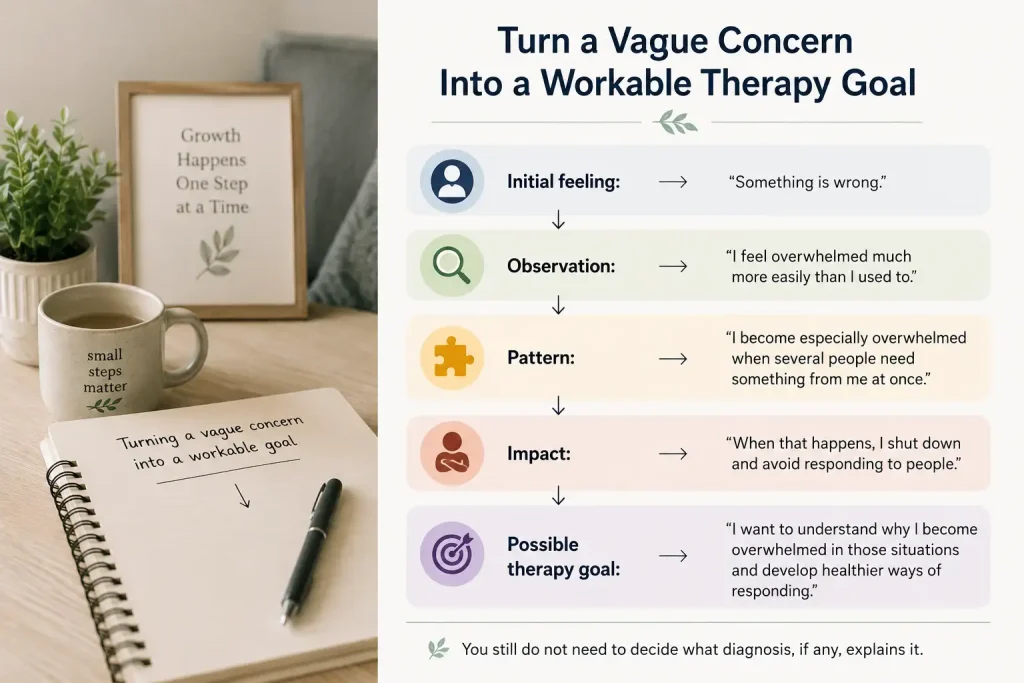
A broad statement can gradually become more specific.
Consider this progression:
Initial feeling:
“Something is wrong.”
Observation:
“I feel overwhelmed much more easily than I used to.”
Pattern:
“I become especially overwhelmed when several people need something from me at once.”
Impact:
“When that happens, I shut down and avoid responding to people.”
Possible therapy goal:
“I want to understand why I become overwhelmed in those situations and develop healthier ways of responding.”
The goal becomes clearer because you moved from an undefined feeling toward a specific experience and its effect on your life.
You still do not need to decide what diagnosis, if any, explains it.
Your First Therapy Goal Can Simply Be Understanding Yourself Better
Sometimes clarity itself is the first goal.
There is nothing inherently incomplete about beginning therapy with:
“I want to understand why I have been feeling this way.”
Exploration can create the foundation for more specific goals later.
You may eventually discover that what initially felt like one problem involves several connected areas. For example, difficulty concentrating might be connected in your experience with stress, sleep, relationship tension, work pressure, or something else entirely.
Rather than choosing a conclusion before therapy begins, you can use the process to better understand those connections.
Separate the Goal From the Solution
Another useful distinction is the difference between what you want to change and how that change may happen.
For example:
Goal:
“I want to handle conflict without immediately shutting down.”
That is different from deciding in advance exactly what therapeutic technique must be used.
Similarly:
Goal:
“I want to understand why I keep avoiding situations that matter to me.”
The goal identifies the area you want to work on while leaving room to explore the reasons and possible approaches.
This keeps the goal focused on your experience rather than forcing you to design your own treatment plan before you have even begun.
What Should You Tell a Therapist If You Cannot Explain the Problem?
You can say exactly that.
You might begin with:
“I know I haven’t been feeling like myself, but I don’t know how to explain it.”
Or:
“I know there are things I want to change, but I’m having trouble figuring out where to start.”
That is enough information to begin a conversation.
You can also describe:
- when you first noticed something changing
- situations that feel especially difficult
- behaviors you want to understand
- emotions that keep returning
- areas of life that feel more difficult
- what you have already tried
- what you wish were easier
The therapist does not need you to arrive with a professionally written list of treatment objectives.
When Can Individual Therapy Help You Clarify Your Goals?
If emotional challenges, stress, recurring patterns, or other difficulties are becoming hard to understand or manage on your own, individual therapy can provide a structured setting for exploring them.
Healing Helps Therapy describes its individual therapy as one-on-one work with Waseem Khalaf, MA, LCPC, focused on emotional challenges, coping strategies, and personal growth. Waseem is a Licensed Clinical Professional Counselor in Illinois. Sessions are available in person in Glen Ellyn, Illinois, as well as through telehealth for clients across Illinois.
You therefore do not need to approach the first conversation with a perfect statement such as, “My therapy goal is X.”
You can begin with what you know now and work toward greater clarity from there.
How to Prepare Before Your First Therapy Session
If you want some structure before the appointment, write down brief answers to these five questions:
- What has felt different or difficult lately?
- When do I notice it most?
- How does it affect my everyday life?
- What have I already tried?
- What would I like to feel or handle differently?
You do not need a detailed journal.
A few sentences, examples, or even individual words can give you a starting point.
For example:
Work pressure
Can’t switch my brain off afterward
Becoming irritated with family
Avoiding messages
Want to feel calmer and more present
That is already enough information to begin identifying possible therapy goals.
You Do Not Need Perfect Clarity Before Starting Therapy
Knowing how to set therapy goals is less about finding the perfect clinical explanation and more about identifying what you notice, what is affecting you, and what you want to become different.
Your first goal might simply be understanding what has been happening.
From there, a broad concern can gradually become a clearer pattern, a clearer priority, and eventually a more specific direction for therapy.
Healing Helps Therapy offers individual therapy in Glen Ellyn and telehealth across Illinois. The practice also offers a free 15-minute consultation as an initial conversation for people considering therapy.
Frequently Asked Questions
Do I need therapy goals before my first session?
No. You can begin by describing what has been bothering you, what has changed, or what you want to understand better. More specific goals can develop as the therapy process continues.
What if I genuinely do not know why I feel bad?
You do not need to determine the cause before talking with a therapist. Begin with what you are noticing, when it happens, and how it affects everyday life rather than trying to diagnose the reason yourself.
What are some simple examples of therapy goals?
Examples could include understanding recurring emotional patterns, managing stress more effectively, communicating more clearly, becoming more comfortable setting boundaries, or understanding why certain situations feel difficult.
Can my therapy goals change?
Yes. Your priorities can become more specific or shift as you better understand your experiences and the patterns affecting your life.
What should I say when a therapist asks why I came to therapy?
Use your own words. A response such as, “I know something feels wrong, but I am not sure how to explain it yet,” can be a valid place to start.